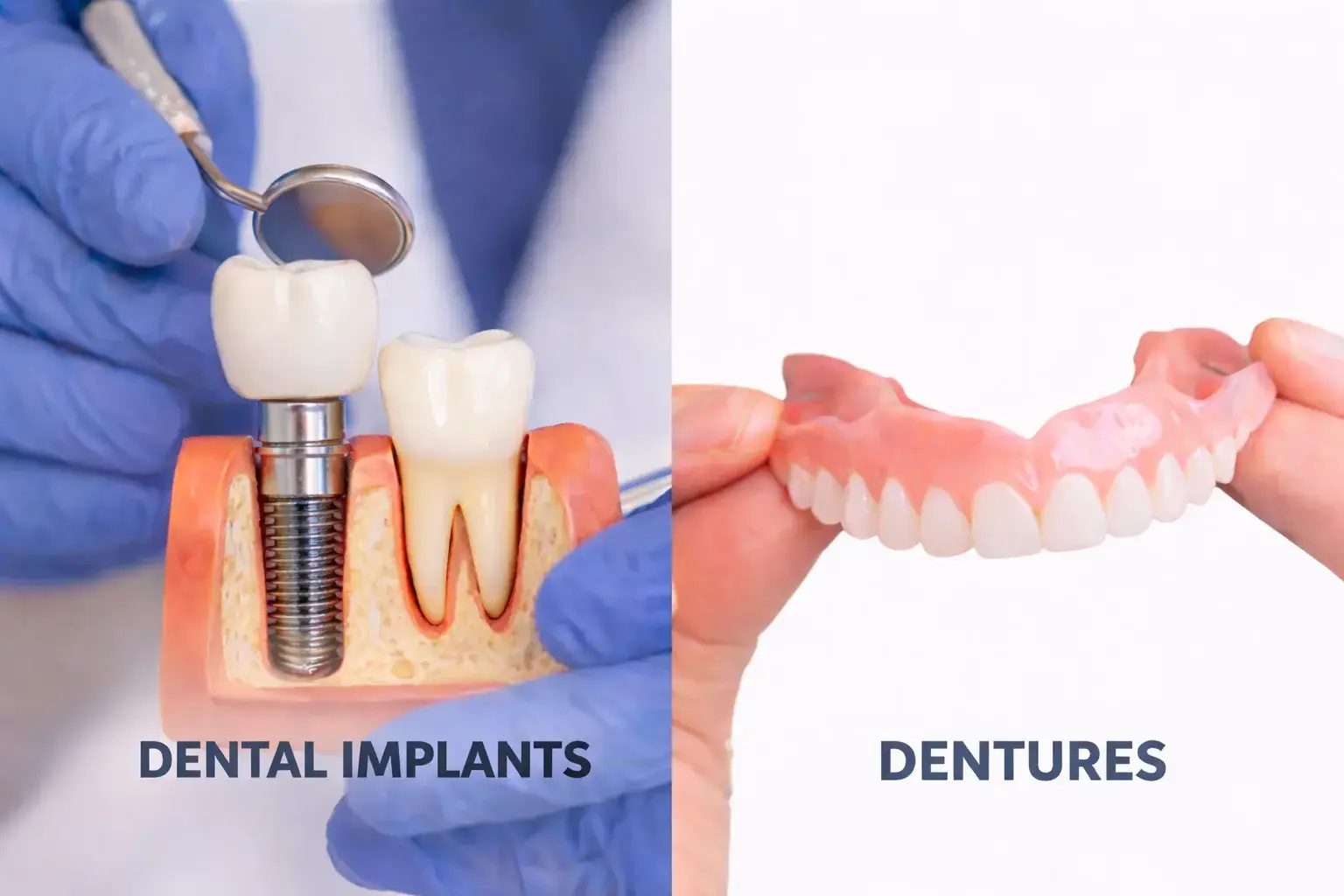
Losing teeth affects more than appearance — it changes how you eat, speak, and feel every day. If you’re a Melbourne patient weighing up your options, the most common question is: should I choose dental implants or dentures?
There’s no universal answer. Both options have real benefits and clear limitations. The right choice depends on your jawbone health, medical history, number of missing teeth, budget, and health fund cover.
This guide walks you through everything you need to make a confident decision.
Table of Contents
What are dental implants?
A dental implant is a small titanium post placed into the jawbone to act as a replacement tooth root. Over time it fuses with the bone — a process called osseointegration — fusing with the jawbone over time.
Because implants are fixed, they feel and function like natural teeth. There’s no removal, no adhesive, and no slipping.
Implants can replace a single tooth, multiple teeth (via implant-supported bridges), or a full arch (All-on-4 or All-on-6).
What are dentures?
Dentures are removable prosthetic teeth attached to an acrylic or nylon base that mimics the appearance of gums.
Types include full dentures (replacing all teeth in an arch), partial dentures (replacing some missing teeth), and implant-retained dentures, which clip onto implants for significantly better stability without the cost of full implants.
Modern dentures are natural-looking and custom-fitted. They require daily removal for cleaning and may need adhesive for stability over time.
Side-by-side comparison
| Feature | Dental implants | Dentures |
|---|---|---|
| Fit | Fixed (non-removable) | Removable |
| Bone health | Prevent bone loss | Do not prevent bone loss |
| Daily care | Brush and floss like natural teeth | Remove, clean, and soak nightly |
| Lifespan | 15–25+ years | 5–8 years |
| Upfront cost | Higher | Lower |
| Surgery required | Yes | No |
| Ready time | 3–6 months (healing) | Weeks |
| Suitable for significant bone loss | Sometimes (may need grafting) | Yes |
Dental implants vs dentures — cost in Melbourne
Costs vary by clinic, complexity, and health fund cover.
General Melbourne price ranges are:
| Treatment | Approx. cost range (AUD) |
|---|---|
| Single dental implant (post + crown) | $3,000 – $7,500 |
| All-on-4 implants (per arch) | $15,000 – $35,000+ |
| Full dentures (complete set) | $5,000 – $8,000 |
| Partial dentures (per arch) | $900 – $2,500 |
| Implant-retained dentures (per arch) | $4,000 – $15,000+ |
“We give you a written, itemised treatment estimate before you start, so you know the expected cost upfront.” — no surprises. We also offer flexible payment options to help spread the investment, and our Springvale and Abbotsford clinics are preferred providers with Medibank, Bupa, HCF, NIB, and a range of other major Australian health funds, which may reduce your out-of-pocket costs.
Are dental implants covered by Medicare or private health in Australia?
Medicare does not generally cover dental implants or dentures for adults. However, some private health funds offer partial cover under major dental or extras policies — the amount depends on your fund and tier.
If you hold a DVA Gold Card, RS Dental’s Richmond Dental Group (Abbotsford) clinic provides eligible services through the Department of Veterans’ Affairs scheme.
It’s worth calling your fund before your consultation to check your annual limits. Our reception team can also help you understand what’s claimable.
Benefits of dental implants
The key advantage of implants is bone preservation. When a tooth is lost, the jawbone begins to shrink (resorption). Implants stimulate the bone and prevent this, helping maintain facial structure and long-term oral health.
Other benefits include a natural look and feel, no food restrictions, no slipping, no impact on adjacent healthy teeth, and a lifespan that often exceeds 20 years with proper care. Most patients report that implants feel like their own teeth after the healing period.
For Melbourne patients looking for a long-term investment in their smile, implants are typically considered the gold standard by dental professionals.
Benefits of dentures
Dentures remain a practical, accessible, and non-invasive solution for many patients — particularly those with significant bone loss, complex medical histories, or tighter budgets.
They are ready within weeks (not months), require no surgery, and modern materials produce very natural-looking results. Implant-retained dentures offer a popular middle-ground: better stability and comfort than traditional dentures, at a lower cost than full implants.
What if I have significant bone loss?
Bone loss is one of the most common barriers to implants, especially in patients who have worn dentures for several years. In many cases, it can be addressed through a bone graft procedure, which rebuilds the jawbone to a level sufficient to support implants.
Bone grafting adds cost and time (typically 3–6 months of additional healing), but it opens the door to implants for patients who might otherwise assume they’re not candidates. At your RS Dental assessment, we’ll evaluate your jaw density using imaging and give you an honest recommendation about whether grafting is needed.
Can pensioners and seniors get dental implants in Melbourne?
Yes — there is no age cut-off for dental implants, provided the patient is in reasonable general health and has adequate (or graftable) bone. Many older Australians are excellent candidates.
Cost is often the primary concern for pensioners. Options worth exploring include health fund cover, the DVA scheme for eligible veterans, and payment plans. Some patients also choose implant-retained dentures as a cost-effective alternative that provides significantly better stability than standard dentures.
Eligible patients may also access certain dental services through the Victorian Government’s public dental scheme — our team can advise whether you qualify at your consultation.
Which is better — dental implants or dentures?
When weighing up your options, the following questions are worth discussing with your dentist:
- How many teeth are missing? For a single tooth, implants are usually preferred. For multiple teeth or a full arch, implants, dentures, or implant-retained dentures are all viable depending on your circumstances.
- What is your jawbone condition? Implants need adequate bone. Significant bone loss may require grafting, which adds cost and time. Dentures can be fitted regardless of bone volume.
- Are you in good health? Certain conditions — including uncontrolled diabetes, active smoking, and some medications — can affect how well an implant heals. Your dentist will assess this at your consultation. Dentures are often safer in higher-risk cases.
- What is your budget and health fund situation? Implants are a larger upfront investment but typically lower cost over a decade when compared to replacing dentures every 5–8 years. Check your extras cover before assuming you’ll pay full out-of-pocket.
- What’s your maintenance preference? Implants are cleaned exactly like natural teeth. Dentures require daily removal, dedicated cleaning, and occasional relining as your jaw changes shape.
Not sure which option suits you? Our Springvale and Abbotsford dentists offer a thorough assessment with a clear, fixed-price treatment plan. Book online or call us — same-day appointments are available for urgent needs.
“Any surgical or invasive procedure carries risks. Before proceeding, you should seek a second opinion from an appropriately qualified health practitioner.”
Book your RS Dental assessment today
At Richmond & Springvale Dental Group, our dentists guide Melbourne patients through exactly this decision every day. We’ll assess your bone density, health history, and budget, and give you a frank recommendation — not a sales pitch.
Visit us at our Springvale clinic (23 Balmoral Ave) or our Abbotsford clinic (377 Victoria St). Same-day appointments are available for urgent dental needs.