Quick Answer: Whitening strips and at-home teeth whitening kits can help reduce mild surface stains, but professional teeth whitening generally provides more controlled and predictable results. The best option depends on the cause of tooth discolouration, existing dental restorations and tooth sensitivity. A dental assessment can help determine which whitening option is suitable for you.
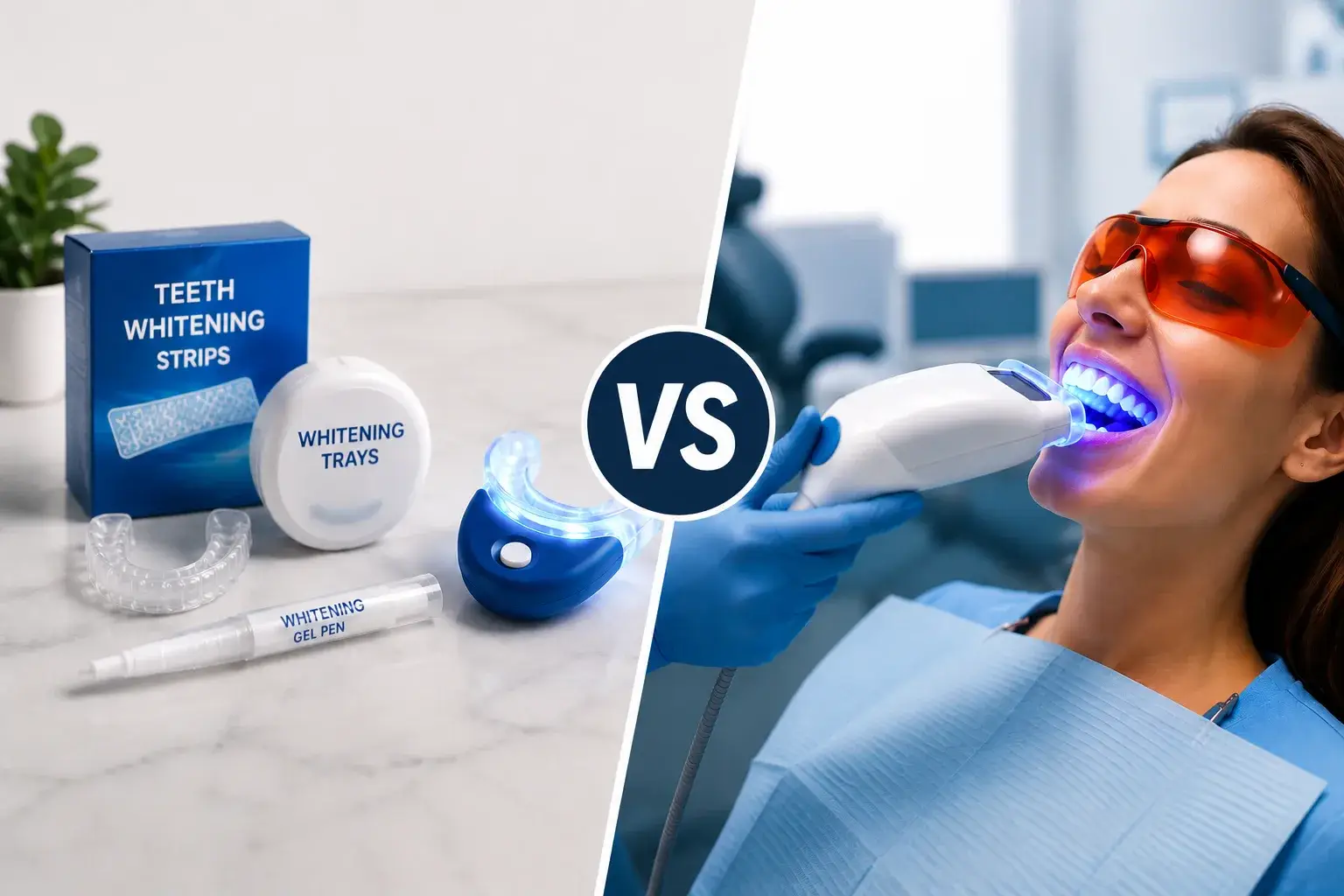
Standing in the pharmacy aisle — or scrolling an online whitening kit bundle with strips, trays, gel pens and LED lights — it’s tempting to grab one and call it done. They’re cheap, easy to find, and promise a brighter smile in days. But do they actually get you the results you’re picturing, or are you better off in the dentist’s chair?
Here’s an honest comparison of at-home options and professional whitening, so you can choose what’s actually right for your teeth, budget and timeline.
Do Whitening Strips and At-Home Kits Work?
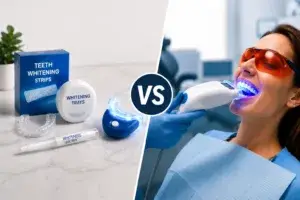
Yes — to a point. Whether it’s strips, a mouth tray, a gel pen, or a full kit with an LED light, most at-home whitening products use a low concentration of peroxide (usually hydrogen or carbamide peroxide) to lift surface stains from coffee, tea, red wine and smoking. Used consistently over one to three weeks, most people see a noticeable but modest improvement — typically one to two shades brighter. LED light kits are marketed as accelerating results, but the light itself does little beyond warming the gel slightly; the whitening agent is doing the real work.
These products are a reasonable option if your teeth are only mildly discoloured and you’re not chasing a dramatic change. Where they fall short is with deeper, more stubborn staining, and most — strips especially — can’t reach every part of your smile evenly — gaps between teeth, curves, and back teeth are easy to miss. Tray-based kits generally give more even coverage than strips, but still use a much lower peroxide strength than anything used in-clinic.
The Downsides of At-Home Strips and Kits
- Uneven results — strips in particular don’t hug the curve of every tooth, so coverage can be patchy.
- Sensitivity — ill-fitting strips or trays can irritate gums, and the peroxide can trigger temporary tooth sensitivity.
- Slower, subtler results — weeks of daily use for a fraction of the brightness a professional treatment delivers.
- Doesn’t work on dental work — no at-home kit, strip or LED device will whiten crowns, veneers, fillings or dentures, which can leave your smile looking mismatched.
What Professional Teeth Whitening Offers
In-chair professional teeth whitening uses a much higher concentration of whitening agent than anything available over the counter, applied and monitored by your dentist. Results are typically visible after a single 60–90 minute session — up to eight shades brighter — and your dentist manages sensitivity throughout the process rather than leaving you to guess.
Take-home kits prescribed by your dentist sit in between: custom-fitted trays with a stronger, dentist-supervised formula than anything sold in stores, giving you professional-grade results on your own schedule.
At-Home vs Professional Whitening: Side-by-Side
| Strips / At-Home Kits | Professional Whitening | |
| Cost | $20–$80 | $300–$800 (in-chair), $250–$550 (take-home kits) |
| Results | Subtle, gradual, 1–2 shades | Dramatic, up to 8 shades, visible after one session |
| Time to results | 1–3 weeks of daily use | As little as 60–90 minutes in-chair |
| Sensitivity risk | Common, especially with ill-fitting strips | Managed and monitored by your dentist |
| Even coverage | Can miss gaps, curves and back teeth | Full, even coverage tailored to your teeth |
| Longevity | Weeks to a few months | 1–3 years with good care |
Which One Should You Choose?
If your discolouration is mild and you’re not in a hurry, whitening strips can be a reasonable starting point. But if you want dramatic, even, long-lasting results — or you have sensitive teeth, dental work, or deeper staining — professional whitening is the safer and more effective route.
For a full breakdown of pricing across both in-chair and take-home options, see our guide on teeth whitening cost in Australia.
Frequently Asked Questions
What’s better, whitening strips or whitening kits?
Neither is clearly better — strips and tray-based kits use similar peroxide concentrations and deliver similar results. Trays tend to give more even coverage since they mould to your teeth, while strips are cheaper and more convenient for quick, casual use. Both fall well short of professional whitening in terms of speed and depth of results.
What is the difference between whitening strips and professional whitening?
Whitening strips use a low concentration of peroxide applied at home over one to three weeks, typically lifting shade by one to two levels. Professional whitening uses a much stronger, dentist-applied formula that can lighten teeth by up to eight shades in a single 60–90 minute session, with sensitivity managed throughout by your dentist.
Does professional teeth whitening work better than strips?
Yes. Professional whitening uses a significantly higher concentration of whitening agent than any over-the-counter strip, giving faster, more dramatic and more even results — and it’s monitored by a dentist, which reduces the risk of gum irritation or uneven coverage that strips can cause.
What is the difference between home whitening and professional whitening?
Home whitening — whether strips, trays, pens or LED kits — uses lower-strength peroxide you apply yourself over days or weeks, with modest results. Professional whitening uses dentist-grade concentrations, either applied in-chair for immediate results or via custom-fitted take-home trays prescribed and supervised by your dentist, giving stronger, longer-lasting, more even results either way.
Are whitening strips or kits as effective as professional whitening?
No — at-home strips, trays and kits use a much lower concentration of whitening agent and typically deliver one to two shades of change, compared to up to eight shades with in-chair professional treatment.
Are LED whitening kits better than strips?
Not meaningfully. LED lights are marketed as speeding up results, but there’s limited evidence the light itself does much beyond mildly warming the gel. A tray-based kit generally gives more even coverage than strips regardless of whether it includes a light.
Can I use whitening strips or kits if I have sensitive teeth?
You can, but strips and at-home kits are a common trigger for temporary sensitivity. A dentist-supervised treatment lets your dentist manage and adjust for sensitivity as they go, which is safer if you already know your teeth are sensitive.
Do whitening strips or kits damage enamel?
Used as directed, most at-home whitening products are safe for enamel. Overuse or leaving them on longer than instructed is where problems occur — which is one advantage of professional treatment being monitored by a dentist.
How long do professional whitening results last?
With good oral hygiene and limiting staining foods and drinks, in-chair whitening results typically last one to three years.
Get a Real Assessment of What Will Work for You
Every smile is different, and the right whitening option depends on your teeth, not just what’s on sale at the pharmacy. Book a consultation with our experienced dentists at our Springvale or Abbotsford clinic, and we’ll help you find the option that actually gets you the smile you want.